
 ↗
MATERIAL APPLICATION STUDY
Photochromic Materials
We explore how reversible, light-responsive colour could become a considered detail in apparel components. This study connects pigment selection, polymer integration and component design for zipper pullers, buttons and fastening accessories. A colour transition or concealed pattern is developed around its activation conditions, recovery behaviour, material compatibility and intended use. Physical samples and documented testing are needed before making performance or production claims.
Exploration
Unexposed
Inactive reference colour
Light exposure
Illustrative colour response
Recovery
Return towards the reference state
01 / Light-triggered transformation
This study focuses on a reversible colour-change direction: an unexposed state, a colour response under a defined light source, and recovery after the stimulus is removed or changed. The concept sequence illustrates that design intention; it is not a measurement of a HEAT sample.
To demonstrate an actual response, record the same identified sample through all three states. Keep camera position, background, exposure and white balance consistent, and distinguish light from the test source from the colour visible on the part. Record the light source, exposure, temperature and elapsed time.
UV fluorescence emits light during excitation; glow-in-the-dark or afterglow materials continue emitting after excitation. Neither is established as photochromic merely because it looks purple under UV. Prism reflections, iridescence and fixed gradients are also different effects. A photograph of two differently coloured objects does not demonstrate a reversible response.
02 / Material & mechanism
Select a documented photochromic system for the intended carrier. Candidate approaches include a compatible pigment or dye, a microencapsulated colorant where specified, or a prepared masterbatch. Not every light-responsive system is microencapsulated, and different systems have different processing and use limits.
For a candidate formulation, review the supplier's technical and safety information, supported carrier systems, activation and recovery behaviour, colour range and processing guidance. Record the grade and batch alongside the prototype. This page does not identify a formulation already selected for every HEAT component.
A clear or translucent carrier can support a visible colour response, but pigment concentration, carrier colour, section thickness, additives and protective layers may alter the result. Evaluate the complete part rather than extrapolating a pigment demonstration to the finished trim.
Integration routes
Resin casting — consider a compatible formulation for a pull-tab insert or decorative button. Review mixing, cure conditions and sample stability before selecting a process; a lower-temperature route is a candidate, not a guarantee of compatibility.
Polymer moulding — review a suitable masterbatch and carrier against processing temperature, residence time and mixing conditions specified by the material supplier. Do not transfer a formulation between polymers without a new review.
Functional coating — consider a light-responsive surface on a metal or polymer component. Adhesion, abrasion, garment contact and exposure through any topcoat need separate assessment.
Preformed insert — explore a responsive element assembled with a separate connector or body. This can allow material and attachment questions to be evaluated separately, but the completed assembly still needs its own assessment. These routes describe development options, not a claim that all are production-ready at HEAT.
03 / Apparel applications
Zipper pullers — explore a localised colour-changing insert, a translucent pull tab, or a concealed motif that becomes more visible during activation. Review grip, edge shape, connector fit and the way the visual detail meets the garment.
Buttons and decorative fasteners — discuss a responsive face or insert while defining holes, shank geometry and attachment separately. Appearance must not substitute for a check of the fastening structure.
Cord ends, stopper covers and adjuster accents — consider whether a small responsive area can provide the intended visual interaction without assigning untested loads or locking functions to the material.
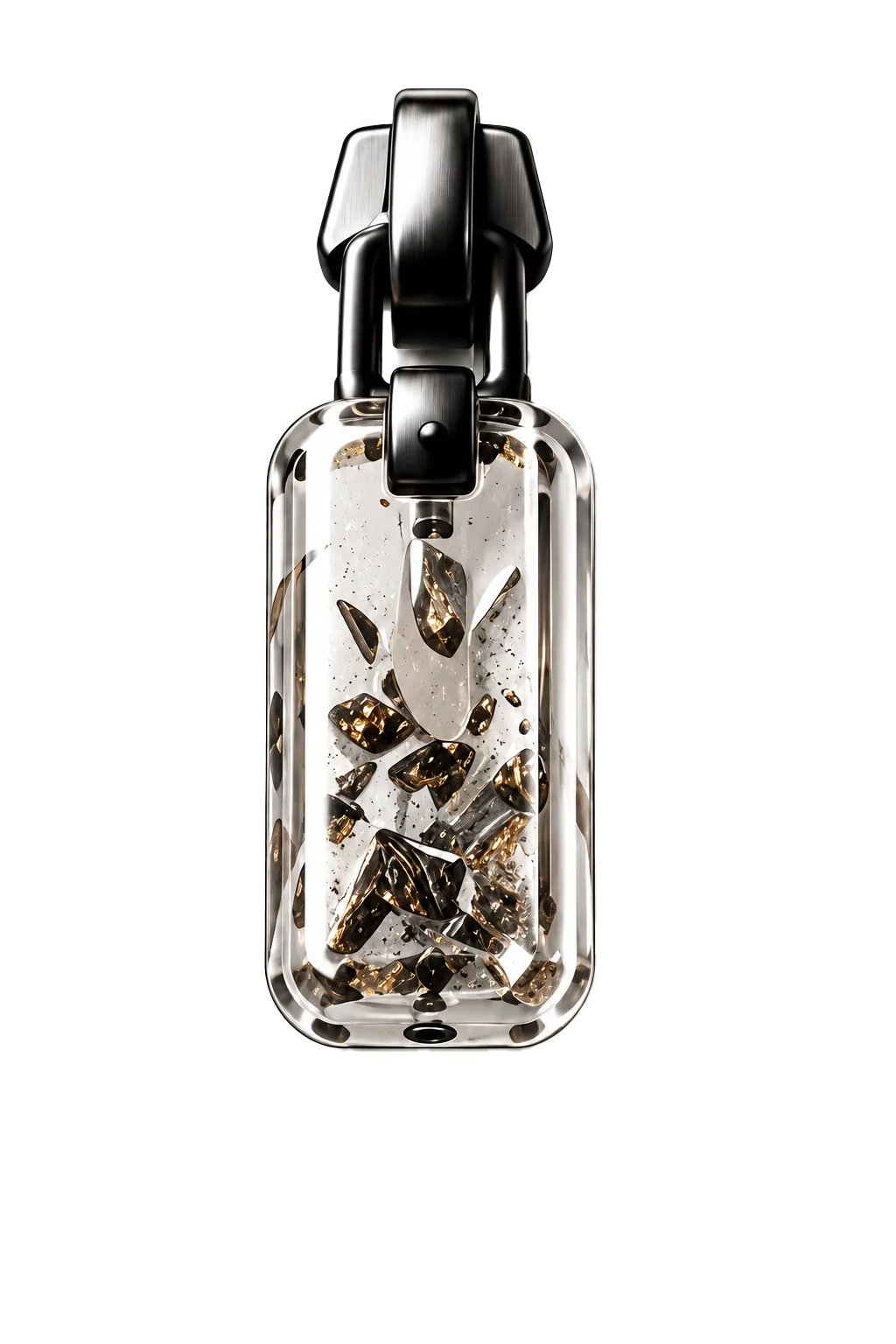
Each concept starts with dimensions, carrier, attachment and expected lighting. A modular insert with a metal connector is one possible starting point; it is not an already-approved sample or a universally preferred construction.
04 / Performance & validation
Activation and colour — record source type and wavelength or spectral range where known, irradiance at the sample, exposure duration, sample temperature and conditioning. Define the unexposed reference and the target colour response before measuring.
Response and recovery — measure time to an agreed colour-change threshold and time to an agreed recovery threshold under specified conditions. Where suitable, record CIELAB coordinates and colour difference using a stated method. No response time, recovery time or activation wavelength is promised for this study.
Repeatability and ageing — assess repeated activation/recovery cycles, sustained light exposure and changes in the initial colour or response. Photochromic response can degrade with exposure; a cycle count without the sample, conditions and acceptance criteria is not a durability claim.
Garment compatibility — agree washing and drying conditions, rubbing or abrasion, coating adhesion where applicable, attachment strength and other application-specific requirements. Link results to a sample ID, grade, batch, specification revision and report. No test results or service-life values are published here.
Test conditions & assessment plan
Record the pigment and carrier formulation, specimen thickness, initial conditioning, exposure spectrum or source, measured irradiance where available, exposure duration, temperature and viewing conditions. Define colour measurement positions, recovery time points and repeated exposure cycles before comparing samples.
Results & application review
A useful result record includes initial colour, activated colour, the change over time and recovery under stated conditions. Compare repeat cycles and appearance after the agreed light, rubbing and garment-care sequence. Qualitative images should use consistent lighting and camera settings; they do not replace sample-specific measurements.
05 / Co-development
Share the target component, approximate dimensions, garment application, preferred inactive and activated colours, and whether the effect should reveal a pattern or change the overall surface. Include the expected lighting environment, care conditions, attachment reference, quantity and timing.
The first sample brief should define the visual question and the evidence needed for the next decision. Material feasibility, colour matching, tooling, assembly and testing are reviewed before committing to MOQ, lead time or a production route.
Recovery and response depend on the selected system and environment. Pigment processing limits, optical shielding, temperature, surface wear and exposure history may affect the observed result. The design direction is decorative; no UV protection, exposure-meter, safety-indicator or lifetime performance claim is made without dedicated validation.
A purple colour, UV glow or prism reflection does not establish a photochromic mechanism. Review the formulation or identified sample evidence before treating a reference as a photochromic application.
No product with a documented photochromic mechanism is currently linked to this study.
Related design references
Response mechanism unconfirmed. These are exploration references, not verified photochromic product cases.
↗